
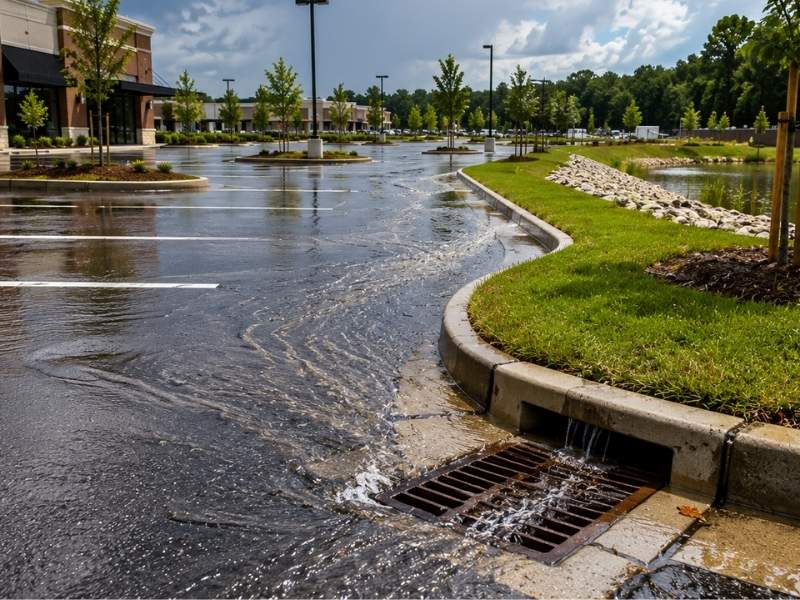
Bad pavement rarely starts with bad asphalt. It starts with drainage design. Water that sits on or under a pavement section breaks down the base, weakens the subgrade and cuts years off the surface life. In Atlanta, where summer storms dump inches of rain in under an hour, getting drainage right isn’t optional. It’s the difference between pavement that lasts 20 years and pavement that needs patching in five.
Why Surface Water Is One of Pavement’s Biggest Enemies
Water and pavement don’t mix well. Standing water on a pavement surface finds every small crack and works its way in.
Once water gets under the surface layer, it softens the base material beneath. Heavy vehicles then load that weakened base. The pavement flexes more than it should. Cracks form. Then more water gets in. The cycle repeats until the surface fails.
This process is called moisture-induced damage, and it’s the leading cause of early pavement failure on commercial sites. The Federal Highway Administration estimates that water-related damage accounts for a significant portion of pavement deterioration across the country each year.
Surface damage shows up in several ways:
- Alligator cracking across high-traffic zones
- Potholes that appear after heavy rain events
- Edge cracking along pavement borders where water pools
- Rutting in areas where water-softened base gets displaced under load
None of these failures are random. They all trace back to water that had nowhere to go.
How Proper Grading Directs Water Away From Pavement
Grading is drainage design’s first line of defense.
A properly graded pavement surface moves water to inlets and away from the pavement edge fast. The standard cross slope for parking lots and access drives is 2 percent. That’s enough to move water without making the surface uncomfortable to walk on or drive across.
Flat spots are a problem. Any area where the grade drops below about 1 percent creates a zone where water slows down and may pond. Ponding causes more surface wear than moving water because the water sits long enough to work into surface imperfections.
What Goes Wrong When Grading Is Off
Grading errors show up in a few common patterns on commercial sites:
- Low points near building entries where water drains toward the structure
- Flat areas in parking fields where inlets were placed too far apart
- Transitions between paved areas and landscaping where water backs up against the pavement edge
- Curb and gutter layouts that create long drainage paths with no intermediate inlets
Each of these creates a zone of standing water. Each zone accelerates pavement wear. A civil engineer checks finished grade contours during design to catch these problems before the paving contractor shows up.
The Importance of Subsurface Drainage Beneath Pavement
Surface drainage handles the water you can see. Subsurface drainage handles the water you can’t.
Groundwater and water that infiltrates through pavement joints or cracks can saturate the base layer beneath the pavement. A saturated base loses much of its load-bearing strength. The pavement section above it then carries loads it wasn’t designed to handle alone.
The pavement design process accounts for subgrade soil conditions. Clay soils, which are common across Georgia’s Piedmont region, hold water. A pavement section over clay needs a subbase layer designed to keep the clay subgrade from pumping water up into the base under traffic loads.
Key subsurface drainage elements include:
- Granular subbase layers that allow water to move laterally
- Perforated underdrain pipes at pavement edges to carry away trapped water
- Geotextile fabric between the subgrade and subbase to prevent clay migration
- Proper compaction of all layers during construction to reduce voids where water collects
Skipping these elements to cut costs is a bad trade. Pavement replacement costs far more than the subbase work that would have prevented it.
How Drainage Design Reduces Pavement Maintenance Costs
Good drainage design pays for itself. The math is straightforward.
A pavement section with proper surface and subsurface drainage can last 20 to 25 years before needing major rehabilitation. A section with drainage problems may need significant patching or overlay work within 8 to 10 years. The cost difference over the life of the pavement is substantial.
For developers, that lifecycle cost matters. A commercial property with deteriorating pavement sends a signal to tenants and buyers. Maintenance budgets that should cover routine work get consumed by early pavement failure.
Routine maintenance on well-drained pavement is predictable. Crack sealing every few years. Seal coating on a regular schedule. Minor patching as needed. That’s manageable.
Routine maintenance on poorly drained pavement is reactive. Pothole patching after every major storm. Base repair when alligator cracking spreads. Premature overlay when the surface deteriorates faster than expected. That’s expensive and disruptive.
Drainage design decisions made during the engineering phase determine which category a project falls into.
Planning for Long-Term Pavement Performance
Long-term pavement performance starts with a design that treats drainage as a system, not an afterthought.
The surface grade, the inlet layout, the base design, the subbase selection and the edge drainage details all have to work together. A good surface grade with no subsurface drainage still fails early in wet soil conditions. Good subsurface drainage under a poorly graded surface still leaves ponding problems above.
A civil engineer sizing inlets uses rainfall intensity data for the project location. In Atlanta, the design storm for most commercial parking facilities is based on a 10-year storm event, which can produce over 3 inches of rain per hour in some conditions. Inlets and storm pipes have to handle that volume without backing up onto the pavement surface.
Long-term planning also includes:
- Specifying pavement sections based on actual subgrade soil reports, not generic assumptions
- Locating inlets to minimize the distance water travels across the surface
- Designing edge treatments that prevent water from undermining pavement borders
- Including cleanout access for subsurface drains so they can be maintained over time
Pavement that drains well from day one continues to drain well with basic maintenance. Pavement that was designed with drainage as an afterthought requires attention from the start, and the problems only compound over time.
Frequently Asked Questions
How does drainage design affect pavement life?
Poor drainage allows water to collect on and beneath pavement, weakening the base and leading to premature cracking, settlement, and pavement failure. Effective drainage moves water away quickly and helps keep the pavement structure dry, extending its service life.
What is the correct cross slope for a commercial parking lot?
A typical commercial parking lot is designed with a cross slope of about 2 percent. This provides adequate drainage while maintaining a comfortable driving surface. Slopes that are too flat can allow water to pond, increasing the risk of pavement deterioration.
Why does subgrade soil type matter for pavement drainage?
Subgrade soil affects how water moves beneath the pavement. Clay soils tend to retain moisture and lose strength when saturated, while sandy soils drain more readily. Understanding soil conditions helps engineers design an appropriate pavement base and drainage system.
What is an underdrain and when is one needed?
An underdrain is a perforated pipe installed beneath or alongside pavement to remove excess groundwater from the pavement structure. It is commonly used in areas with poorly draining soils, high groundwater levels, or locations where water tends to accumulate beneath the pavement.
How often should drainage systems beneath pavement be maintained?
Drainage systems should be inspected regularly to ensure they continue functioning properly. Surface inlets should be cleared of debris after major storms, and subsurface drainage components should be inspected periodically to identify blockages or sediment buildup that could reduce performance.
