
Many warehouse traffic studies focus heavily on trucks and give too little weight to employee cars. Trucks matter, but the sharpest daily spike at a large distribution center often comes from hundreds of workers arriving and leaving within the same half hour. That surge can back up driveways, overload nearby intersections, and push cars into truck lanes. A traffic study that looks closely at shift changes helps developers, owners, and site designers plan access that works on day one and as operations grow.
How Warehouse Shift Changes Affect Traffic Patterns
A shift change is the window when one crew leaves and the next one arrives. For a short time, both groups are on site, and two waves of traffic move in opposite directions at the same driveways. Large fulfillment and distribution buildings may run two or three shifts a day, with each change producing its own peak. Those peaks don’t always line up with the morning and evening rush hours that most road studies focus on.
That timing can work for or against a project. A 6:00 a.m. shift change may land when nearby roads are light, while a 3:30 p.m. change can overlap with school dismissals and early commuter traffic. The parking lot also feels the overlap, since incoming workers need open spaces before outgoing workers have left. Planning only for average demand often leaves the site short during these brief but intense periods.
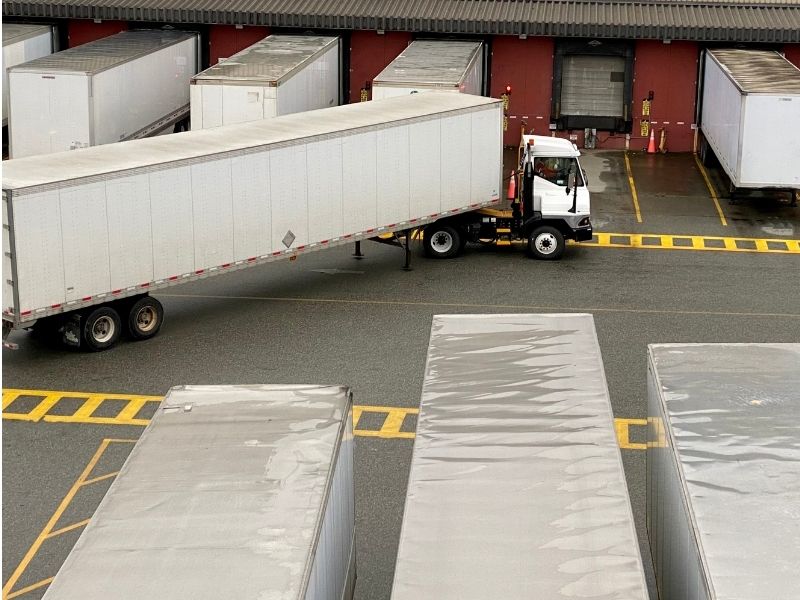
Truck activity adds another layer. Dock schedules, carrier pickup times, and yard moves may cluster around the same hours as shift changes. When cars and tractor-trailers share entrances, slow-turning trucks can hold up dozens of vehicles behind them.
Evaluating Peak-Hour Traffic and Employee Vehicle Volumes
A traffic study estimates how many vehicles a site will add to the road network during its busiest hours. For warehouses, engineers often start with published trip generation data, such as the ITE Trip Generation Manual, which includes several warehouse and distribution categories. Those averages are a useful baseline, but they may not reflect a specific operator’s staffing plan. When the tenant is known, actual headcounts and shift schedules usually give a more accurate picture.
The study should look at the site’s own peak hour and the road network’s peak hour. Engineers typically convert employee counts into vehicle trips using expected carpooling, transit use, and drop-offs. Then they spread those trips across the arrival and departure windows. A short, tight window produces higher peak volumes than a staggered one.
Parking demand comes from the same numbers. During a shift change, the lot may need spaces for both crews at once. Sizing parking for that overlap, or planning operational fixes, keeps workers from circling the lot or parking along access drives.
Reviewing Truck Access, Driveways, and Intersection Capacity
Truck access is a core part of any warehouse traffic study. Engineers check that tractor-trailers can turn into and out of the site without crossing into opposing lanes or climbing curbs. Turning templates based on a design vehicle, such as a WB-67 tractor-trailer, help size driveway widths and curb radii. Grades at the driveway also matter, since loaded trucks accelerate slowly on uphill exits.
Driveway layout has a big effect on shift-change performance. Many sites separate truck and car entrances so slow truck movements don’t block employee traffic. Each driveway needs enough throat length, meaning the distance between the street and the first internal conflict, to hold queued vehicles off the public road. Short throats are one of the most common causes of backups onto adjacent streets.
Nearby intersections are usually the real bottleneck. The study models how added car and truck traffic affects delay and queue lengths at each location. Results are often expressed as level of service, a letter grade that summarizes delay. If an intersection fails under future conditions, the study may recommend turn lanes, signal changes, or other improvements.
Traffic Study Requirements for Warehouse Site Development
Many jurisdictions require a traffic impact study for large warehouse projects. Requirements vary widely by city, county, and state agency. Some set a trip threshold that triggers a study, while others decide case by case based on location and road conditions. State transportation departments may also review projects that connect to state highways.
Scoping is the first step. Before work starts, the engineer and the reviewing agency typically agree on study intersections, analysis periods, growth assumptions, and any special conditions such as shift changes. Getting that agreement early avoids rework and surprise requests late in the approval process.
The study can affect more than the road plan. Recommended turn lanes, driveway relocations, or widened pavement can change the site layout, grading, drainage, and stormwater design. Pavement design for truck routes may also need heavier sections to handle repeated axle loads. Coordinating the traffic study with civil engineering design keeps these changes from colliding late in the project.
Improving Traffic Flow Through Shift Scheduling and Site Design
Some of the most effective fixes are operational. Staggering shift start and end times by even 15 to 30 minutes can spread the peak and reduce queues. Moving truck dock appointments away from shift change windows keeps cars and trucks from competing for the same driveways. Many operators pair these steps with carpool programs or shuttle service to cut vehicle counts.
Site design does the rest. A good layout gives employees a clear, direct route from the entrance to parking and keeps trucks on their own path to the docks and yard. Internal stacking space, wide drive aisles, and well-placed pedestrian crossings help the site absorb a surge without spilling onto public roads.
- Separate car and truck driveways when the site and access rules allow it.
- Longer driveway throats where shift-change queues are expected.
- Parking fields sized or phased for shift overlap and future expansion.
- Turn lanes or signal changes recommended by the traffic study.
Each choice affects cost, land use, grading, and drainage. Talking through them with the civil engineer and traffic engineer during site planning helps the team find the right balance.
Frequently Asked Questions
What is a traffic study for a warehouse?
A traffic study estimates how a warehouse will affect nearby roads and intersections. It looks at employee trips, truck trips, and peak periods. The study then identifies problems and recommends improvements. Agencies often use it as part of the site approval process.
Why do shift changes matter in a traffic study?
Shift changes create short, intense peaks in employee traffic. Arriving and departing crews can be on site at the same time. Those peaks may not match normal commuter rush hours. Studying them helps size driveways, parking, and intersection improvements.
Is a traffic impact study always required for a warehouse?
Not always. Requirements depend on the jurisdiction, project size, and expected trips. Some agencies require a study above a set threshold, while others decide case by case. Contact the reviewing agency early to confirm what’s needed.
How do trucks affect driveway design?
Trucks need wider driveways and larger turning radii than cars. Engineers use turning templates to check that trucks can enter and exit safely. Grades and sight distance also affect truck movements. Separating truck and car access often improves safety and flow.
Can changing shift times reduce required road improvements?
Sometimes it can. Staggered shifts spread trips over a longer period and lower peak volumes. Some agencies accept operational measures when they’re documented and enforceable. Your traffic engineer can test scenarios to show the effect.
